5.- Rather, we must ask ourselves what do we mean by “Council”? what do we mean by “superior”? which are the two terms of our title.
By Council, of which Can. 627 recalls the need, is meant the group of definitors, assistants, councilors, consultors according to the terminology in use in different congregations and orders. Still, regarding its nature, we must recognize that today there is not a shared view about all the points among canonists themselves. Moreover, especially about some details, they find themselves debating strongly among themselves.
We could polarize our reflection beginning with three questions:
1) Is the superior part of the council? Can we say that he/she is a member of it?
2) Does she/he have the right to vote?
3) Can she/he break a tie vote that arises in council?
Ad 1m. : We could represent the problem in these terms:
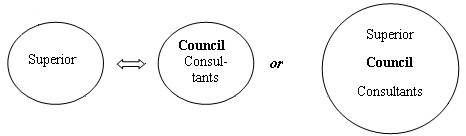
In the 1st Case the superior is not part of the council and it cannot be said that he is a member.
We rightfully talk about the “superior’s council” or the “superior and his/her council”.
In the 2nd Case the council is the “whole made up of the superior and the councilors” or,
again, it is expressed saying: “the superior and the councilors together form the council”.
I believe that from a strictly canonical viewpoint, that is, based only on the letter of Canon Law, there are no doubts: Can. 127 is clear in presenting the juridical person or group of persons as distinct from the same superior who asks consent. Concretely, the 1st Case is valid, while it seems that there is no room for the 2nd Case. The function of the college or group of which Can. 127 speaks is not that of deciding through a vote, but to help the superior in the process of arriving at his/her decision: the will of the superior and the will of the group of councilors seem to have clearly distinct objects. Therefore it seems to me that question n. 2) reported above, that is if the superior has the right to vote, is resolved at root, with a negative response. We would have to respond “nego suppositum” because this question comes up only in the 2nd Case. The superior cannot concur to form the majority because of not belonging to the same college or group of persons from which he/she must have the consent or opinion in order to be able to place his/her juridical act validly. Besides, that the superior not have right to give a vote with the others, nor to break a tie in votes, is certified by an authentic interpretation of the Pontifical Commission for the authentic interpretation of the Code of Canon Law of August 1, 1985, two years after the promulgation of the present Code.
Still, one cannot say exactly that the 2nd Case is totally refused. What’s more there are irrefutable historical data that tell us that it is tolerated. In fact, even after this interpretive document on Can 127, the Holy See has continued to approve Constitutions that confer the right to vote on the superior and consider him/her a member of the same council; therefore not taking into account Can. 127 § 1. This is a real snag, and litres of ink have been poured out over this (or better, thousands of strikes of characters!)
It is true that each institute of consecrated life and each society of apostolic life has its own charism which must be jealously guarded and promoted, and that, since this is manifested in the form of government, and according to Can 586, §1 “there is acknowledged a rightful autonomy of life, especially of governance”; it is true, consequently, that also the juridical figure of the council must reflect the proper nature of the Institute and depend on its charism. It is true that the Apostolic See and the diocesan bishop must approve that charism without crushing it and wounding it; but it is also true that, although I feel more spiritual than canonist, rather precisely because I feel more spiritual than canonist, I cannot not take into account (cannot fail to take into account) Can. 627, § 2, which determines not only that proper right can establish, besides cases covered by universal law, other cases that require the consent or the opinion of the Council, but also that in each case you must proceed according to Can. 127. Note that this is the only time in the whole Code of Canon Law where Can. 127 is expressly recalled by the legislator. As Ghirlanda points out (Atto giuridico e corresposabilità ecclesiale [can. 127 CIC]” Periodica 90 (2001), 243-244), the will of the legislator “to submit at least by rule, the Councils of Superiors of Institutes of Consecrated Life and of Societies of Apostolic Life to the discipline of Can. 127” is evident. It seems to me that the practice of the Apostolic See that continues to approve Constitutions that confer on the Superior the right to vote and consider him/her a member of the council itself, goes contrary to the CCL and facilitates collegial governance which, on the other hand, the See itself refuses.
In fact, if on the one hand, there is in the Church the obligation that, without any exception, every real and canonical superior must have a council that helps her/him in governance as an organism of participation and consultation which he/she must make use of in the exercise of office (cfr. Can. 617 § 1: “According to the norm of the constitutions, superiors are to have their own council, whose assistance they are to use in carrying out their office”), on the other hand, the Church herself does not consider the council an organism of governance strictly speaking, but rather of collaboration in governance; nor does she consider the councilors as superiors and excludes outright an “ordinary and exclusive collegial government whether for the whole institute, or for the province, or for every individual house, in such a way that the superior, if there is one, be a mere executor” (decree “Experimenta” of February 2, 1972, on the point of ordinary governance, AAS64 (1972), 393-394). [[[To avoid any misunderstandings, keep in mind that “collegial government” is not synonymous with “chapter government”: also institutes (e.g., monastic) with chapter regime, must have a personal government of a superior, without reducing that person to being a simple executor of what is determined in chapter!]]] Especially in early post-conciliar time, we witnessed a reaction against the authoritarianism and the personalism of certain superiors, a reaction that led to the suppression of the very figure and role of the superior, with a consequent vacuum of authority and responsibility. It would have been much more useful and effective, instead, to fight the defects through the promotion of a spiritual governance that needs an openness of awareness and a profound personal relationship between superior and subject, impossible to bring about in the situation of a collegial government. Moreover, this collegial government actually led to legal hardening, which made it more difficult to develop a genuine and deep co-participation, co-responsibility and subsidiarity. The CCL suggests, as I see it, a more spiritual view of governance than that of certain canonists or spiritual theologians who, to eliminate the problem of locked councils, think of giving voting right to the superior, at least to break a tie ( 2+2), or, thinking they are progressive, call for a collegial type government as better for religious life, because it is currently more in accord with the spirit of our times. Why do I say that it is “more spiritual”?
1) because it has the courage not to put institutes of consecrated life and societies of apostolic life on the path blazed by today’s sociological situation: a collegial government more easily becomes bureaucratic and capable of crushing the person (“What can appear more democratic”, as Ghirlanda observes, “can be revealed more oppressive of the person”. (ibid., 247)
2) and, above all, because it has the humility not to want to resolve in a strictly canonical way,
with only canonical instruments, strictly spiritual questions that require reflection in prayer, in depth, on the part of each individual and the operation of a spirit of communion, precisely of Vatican II, which requires of everyone an effort and an ascetic commitment beyond a purely technical framework of legislative data. Basically it is the CCL itself that, with its emphasis on the personal nature of governance, defers to the studies of spiritual theology that we will seek to clarify now in the second part, as, moreover, it should be the correct sense of spirituality and genuine seeking for God’s will to promote the good of the community and of individuals to induce us to make reference to canonical data.