Re-reading of the various data in a spiritual and synthetic key
1.- In this second part we will try to do a re-reading of the data heard in the first part. There can be many keys (lenses) for a spiritual re-reading of this information regarding the relationship between the superior and her/his council. I will indicate three, even though, in fact, they can be seen as complementary and it would be good to integrate the three of them.
a) The strong point of the first, or its key word is “Communion” in the Church. It seems to me this is the way followed, for example, by G. Ghirlanda in the article quoted above in Periodica, to which I defer. Here I will be satisfied with saying only that he points out the ecclesial sense of the question and considers the relationship between superior and council in light of the type of “communion” existing in the Church and affirmed clearly by Vatican II. We must overcome the logic of opposition between the superior and the council, without, however, falling into annulling the distinction between these two subjects working for the good of the congregation and its individual members. It is communion itself, operating in the Church and building the Church, that demands a unity in diversity. “Communion”, “co-responsibility”, “participation”: these are some fundamental topics to study in a spiritual line to reconcile the data that the CCL offers us to grasp the true nature of the council, in a way that it can be realized according to the desires of the Church for the good of the whole body or the community, and for progress in the Spirit and the sanctification of its individual members. Being placed in this light, it is easier to integrate and understand the deep significance of many instructions of the CCL and evaluate better the relationship between proper or particular law and universal law, and, in general, also the practice of the Apostolic See which seems to contradict positions held by the CCL or the Commission for the interpretation of the Code.
b) A second way or lens for studying the topic of the relationship between superior and council is the development of the topic of “Counseling in the Church” in light of the broader topic of “Communicating in the Church”. For a useful study of this topic, I defer to Martini’s article in the bibliography. I don’t want to spend time on it either, especially for lack of time.
c) The third way that I would like to follow with you a little is that of trying to frame the whole question of relationship between superior and council and to take up again both Ghirlanda’s perspective of “communionality or sense of Communion in the Church”, and that of Card. Martini’s “Counseling in the Church” in the more general topic of “spiritual governance”; and this, in its turn, in light of the topic of “Communitarian spiritual discernment”.
For the understanding of “spiritual governance” it is surely helpful to show how it can be concretely brought about in the dynamics of arriving at a decision that involves a process of spiritual discernment. In order for a government decision to be spiritual it must develop in a dynamic of discernment. There is a close relationship between the government of the superior and the dynamics of election [Note: “quid est” (what is) election in the U.S.?]. Like any decision made through a process of spiritual discernment, also the Superior’s governance can be seen as an operation which develops according to definite rhythms and lines of strength, beginning and availing oneself of the help of data and contents of various kinds, of different value and significance (historical, juridical, theological, spiritual, etc…), in which various persons intervene (in our case, besides the Holy Spirit, the superior and the subject, also the members of the council), and which presupposes a definite spiritual climate and environment. We can represent the process of arriving at a decision of governance of the superior, using the outline of “See/Discern/Decide”, fundamental of election, that is of the free choice of God’s will known and loved in the here and now of concrete history in regard to the subject or the community, and referring, in a corresponding way, to the anthropological structure of the three powers of the “Memory – Intellect – Will/Freedom” and to the dialectic “Experience – Reflection – Light from Above – Experience …” in the following way:
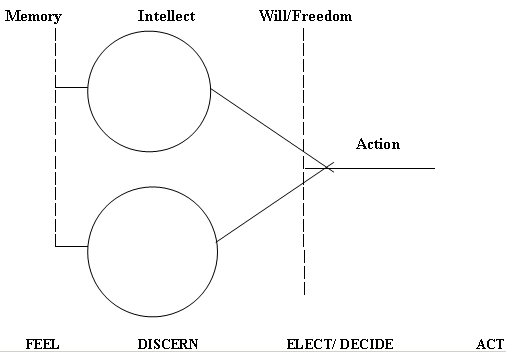
EXPERIENCE REFLECTION LIGHT FROM ABOVE EXPERIENCE
SECRETARY COUNCIL SUPERIOR PROCURATOR
INFORMATIVE CONSULTATIVE DELIBERATIVE EXECUTIVE
The energies of the superior, precisely because she/he is a single, limited person, are unequal to fulfilling the entire governance process alone. The most delicate point is that of decision-making, point 3, that of the decision, of electing, toward which the first two points are directed and which is presupposed at point 4. It is right that it be reserved to the superior. For other times, both that of the formation of the decision (decision-making: points 1 and 2), and that of the execution of the decision (point 4) the superior needs to have help: the task of the memory (or better to help him in memory) is entrusted especially to the secretary; the task of the intellect (or better to help him in the intellect and discerning) is entrusted especially to the councilors, to the council, etc…; the task of helping him in the execution is entrusted to the procurator. If it is true that it is basically the superior who has the competency of making the decision and, therefore, perform the function which in the human person belongs to the will/freedom, it is no less true that the rightly-ordered human will does not move if not moved or at least enlightened, even if not determined, by the intellect. The superior who would want to govern without the help of the council would fall into the voluntarism which translated into government terms we would call authoritarianism. If, instead, on the opposite side he always had the councilors and council determine for him, deteriorating into a type of habitually collegial government, he would renounce his freedom and would fall into a rationalistic government that would impede the personal dimension of his government, redesigning it not according to the Spirit, but according to the forces from below which more easily crush the subject. In fact, since it is unthinkable that the subject can be profoundly open with all the council members, the governmental decision that would relate to him might not take sufficiently into account the personal information which God also uses to make known his will.
The re-reading of the work of a superior’s governance with the council in light of the process of spiritual discernment permits us to understand other important elements of the relationship between the superior and council and the latter’s function.
If the council, in fact, is placed at the central moment in the process of a decision’s maturation through discernment, it seems to me that certain statements often made regarding its nature and the identikit of councilors become clearer. For example:
1. that the Council’s work is eminently a work of spiritual discernment, understood in the most specific form; that is, not so much as operative discernment (which is proper to the superior and which, if it were habitual for the council, a collegial government would follow), but as discernment of the motions, criteria, motivations, in short: the information/data around which the operative discernment and deliberation of government is realized;
2. that, consequently, the council’s activity, as an exercise of discernment, must be seen more in reference to God than to the congregation’s members, more as gift of the Spirit than as the exercise of an authority or a power, that is a consultative power, more in relationship to the gift of the council than to techniques or methods of a sociological or pedagogical type;
3. that, consequently, the council would have to be assured of the most complete collection of data that ought to enter into question (that is, in practice, that the work of the memory be done correctly);
4. that, more particularly the consultors or councilors, both as individuals and as members of the council, must assure those qualities that are required for any spiritual discernment, both personal and communitarian. Therefore, one expects the individual consultor to know how to nourish not only her/his own sense of God, primacy of the Spirit and interior life through prayer, contemplation and familiarity with Christ (because giving advice is an activity that enters into the picture of communicating spiritually, communicating from one’s interior), but also a sense of the entire reality, the world, the Church, the congregation of which he/she must feel a “part”, and a passion for good, for the positive, rather even, for the better (not “what’s wrong in that”, but “how to do it better/best?”);
5. that the work in council and of the council as such must be lived as a moment of personal reflection, but also community reflection, closer to study than to simple communication of information or, even worse, of chatting/gossip; more as a moment and exercise of dialog (which involves the integration of general information with specific information, integration of revealed data with natural data, values with historical data, of community data or data related to community with personal data or that related to the individual, etc…) than as a moment of conversation, or on the contrary, of simple discussion. Also for this reason the reference to council work to the community discernment process recalls how the work in council must be marked by those adjectives and adverbs that characterized communication in the primitive Church: it is a question of always keeping in mind the building up of the community (1 Cor 14:12), to prophecy one at a time (1 Cor 14:31), “decorously and with order” (1 Cor 14:40), with care (Phil 2:28), with humility (Phil 2:3), with gentleness (Gal 4:1), with openness (Gal 6:20), without confusion or wasting of energies, and therefore to overcome impulsiveness, inopportune, untimely and disorderly interventions, (cfr. MARTINI, “Il consigliare nella Chiesa” [Counseling in the Church] Ambrosius 65 [1989], 242-243). At the same time it recalls that the consultor must have a genuine capacity for reflection, dialog, docility to the Spirit and must be able to grasp the Spirit’s interior movements; along with this he/she must have a great love for objective truth and an enjoyment for investigation and research.
6. that still, as council, the council does not precisely deliberate, but…advises. The councilors do not have a deliberative vote, but a consultative one. The deliberative power in ordinary government is only in the superior; and if on the superior’s part there is a vote, as we will see later, this is only to permit or not permit the superior to act. The council is not an ongoing general or provincial chapter (general or provincial congregation according to the various terminology in different institutes of religious life). It concerns the ordinary, not extraordinary, government of the institute. We cannot confuse one with the other; that is, we cannot make what is extraordinary, ordinary. But it also remains true…
7. that the councilors, by the fact that they have no deliberative vote, are not “worth less” than the superior who has it. Certain expressions like: “unfortunately we have only consultative power” or similar ones are the manifestation not only of a thirst to have also deliberative power, thinking one will “be more” because he/she “has more” [error also from just the human viewpoint because it shows confusion between “being” and “having” which is the basis for an even more diabolical confusion between “being” and “appearing” – which occurs when people think they are more because they appear more powerful!], but they are also the manifestation of an “anthropological deviation”, because they think, in practice, that the will is more than the intellect (voluntaristic mentality which leads to pharisaic and dictatorial absolutism: Mussolini!). Often people want to fight this deviation (=authoritarianism of the superior) with an equally pernicious error, that of making the superior (=will) a simple executor of the council (=intellect). But this is rationalism; it is ideologism: and consecrated life in the Church today really seems to be quite weakened by this.
Some of you, starting off precisely from your experience, could raise an objection saying that, even without falling into collegial governance and even without wanting to make their contribution as council a substitution of the superior’s governance, actually the council is called to vote and, therefore, to manifest decisions: how does this fit into the view of spiritual governance according to the discernment process?
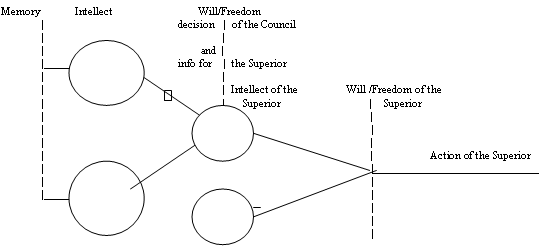
The decision of the council that the superior receives as instrument and information for discerning what she/he will decide, can be expressed according to the Code of Canon Law as consent or as opinion. If consent or opinion is required, this is established by the universal law of by the particular law of each institute.
When it says that consent is required:
Ø the superior cannot act without having obtained it by an absolute majority of the votes present or by the majority established by the particular statutes. If he/she acts without it, the decision, the act of governance is invalid. We could say, going back to the figure above that the superior cannot proceed beyond in his/her discernment in view of the decision to be made: he cannot decide.
Ø Should the superior obtain the consent he is not obligated to proceed along the line indicated by the council. Why? Precisely because the council is not an organ of collegial governance; and, even after having expressed its opinion, it cannot necessarily bind the decision of the superior, who, in spite of the vote favorable to him, could have picked up elements during the discussion or in the reasons that emerged in the council, that can lead him to change his mind about his own initial choice and even, after a due personal discernment – expression and statement of personal governance proper to a spiritual governance --, to overturn it.
Ø It is always necessary to reach a vote: it is not sufficient that the councilors express their opinion freely and discuss among themselves, without arriving at a formal vote, even though the result of it and the position of the council might appear very clear.
When it says that the opinion is required:
Ø The superior, to act in such a way that his/her decision be a juridically valid act, cannot fail to convoke the council.
Ø It is not necessary that the discussion come to a vote; it suffices that all have had the opportunity to express themselves.
Ø Even though they arrive at the formulation of a vote (sometimes useful to clarify about major or minor convergence of the council about a specific position), the superior is not even obliged to follow the opinion expressed by the majority.
What we are saying, it seems to me, enlightens well why one cannot or ought not confuse and identify consent and deliberative vote, on the one hand, and similarly on the other hand, opinion and consultative vote. In addition, it seems to me that also the re-reading of a superior’s governance and the function of his/her council through the lens of spiritual discernment can give better reasons, both, for the separation of subjects in ordinary governance between superior and council (the superior is not a member of the council) and for the spiritual nature of governance of both the subjects, and how, just in assuring the nature of one and the other way of governing, that is, of promoting the common good according to each one’s specificity, one can grasp the wealth that derives from their complementarity.