IV
DUST
"Let the Bodhisattva look upon all things as having the nature of space, - as permanently equal to space; without essence, without substantiality." - SADDHARIMA-PUNDARÎKA.
I HAVE wandered to the verge of the town; and the street I followed has roughened into a country road, and begins to curve away through rice-fields toward a hamlet at the foot of the hills. Between town and rice-fields a vague unoccupied stretch of land makes a favorite playground for children. There are trees, and spaces of grass to roll on, and many butterflies, and plenty of little stones. I stop to look at the children.
By the roadside some are amusing themselves with wet clay, making tiny models of mountains and rivers and rice-fields; tiny mud villages, also, - imitations of peasants' huts, - and little mud temples, and mud gardens with
ponds and humped bridges and imitations of stone-lanterns (tôrô); likewise miniature cemeteries, with bits of broken stone for monuments. And they play at funerals, - burying corpses of butterflies and semi (cicadæ), and pretending to repeat Buddhist sutras over the grave. To-morrow they will not dare to do this; for to-morrow will be the first day of the festival of the Dead. During that festival it is strictly forbidden to molest insects, especially semi, some of which have on their heads little red characters said to be names of Souls.
Children in all countries play at death. Before the sense of personal identity comes, death cannot be seriously considered; and childhood thinks in this regard more correctly, perhaps, than self-conscious maturity. Of course, if these little ones were told, some bright morning, that a playfellow had gone away forever, - gone away to be reborn elsewhere, - there would be a very real though vague sense of loss, and much wiping of eyes with many-colored sleeves; but presently the loss would be forgotten and the playing resumed. The idea of ceasing to exist could not possibly enter
a child-mind: the butterflies and birds, the flowers, the foliage, the sweet summer itself, only play at dying; - they seem to go, but they all come back again after the snow is gone. The real sorrow and fear of death arise in us only through slow accumulation of experience with doubt and pain; and these little boys and girls, being Japanese and Buddhists, will never, in any event, feel about death just as you or I do. They will find reason to fear it for somebody else's sake, but not for their own, because they will learn that they have died millions of times already, and have forgotten the trouble of it, much as one forgets the pain of successive toothaches. In the strangely penetrant light of their creed, teaching the ghostliness of all substance, granite or gossamer, - just as those lately found X-rays make visible the ghostliness of flesh, - this their present world, with its bigger mountains and rivers and rice-fields, will not appear to them much more real than the mud. landscapes which they made in childhood. And much more real it probably is not.
At which thought I am conscious of a sudden soft shock, a familiar shock, and know
myself seized by the idea of Substance as Non-Reality.
This sense of the voidness of things comes only when the temperature of the air is so equably related to the temperature of life that I can forget having a body. Cold compels painful notions of solidity; cold sharpens the delusion of personality; cold quickens egotism; cold numbs thought, and shrivels up the little wings of dreams.
To-day is one of those warm, hushed days when it is possible to think of things as they are, - when ocean, peak, and plain seem no more real than the arching of blue emptiness above them. All is mirage, - my physical self, and the sunlit road, and the slow rippling of the grain under a sleepy wind, and the thatched roofs beyond the haze of the rice-fields, and the blue crumpling of the naked hills behind everything. I have the double sensation of being myself a ghost and of being haunted, - haunted by the prodigious luminous Spectre of the World.
There are men and women working in those
fields. Colored moving shadows they are; and the earth under them - out of which they rose, and back to which they will go -is equally shadow. Only the Forces behind the shadow, that make and unmake, are real, - therefore viewless.
Somewhat as Night devours all lesser shadow will this phantasmal earth swallow us at last, and itself thereafter vanish away. But the little shadows and the Shadow-Eater must as certainly reappear, - must rematerialize somewhere and somehow. This ground beneath me is old as the Milky Way. Call it what you please, - clay, soil, dust: its names are but symbols of human sensations having nothing in common with it. Really it is nameless and unnamable, being a mass of energies, tendencies, infinite possibilities; for it was made by the beating of that shoreless Sea of Birth and Death whose surges billow unseen out of eternal Night to burst in foam of stars. Lifeless it is not: it feeds upon life, and visible life grows out of it. Dust it is of Karma, waiting to enter into novel combinations, - dust of elder Being in that state between birth and birth which the Buddhist calls Chû-U.
It is made of forces, and of nothing else; and those forces are not of this planet only, but of vanished spheres innumerable.
Is there aught visible, tangible, measurable, that has never been mixed with sentiency? - atom that has never vibrated to pleasure or to pain? - air that has never been cry or speech? - drop that has never been a tear? Assuredly this dust has felt. It has been everything we know; also much that we cannot know. It has been nebula and star, planet and moon, times unspeakable. Deity also it has been, - the Sun-God of worlds that circled and worshiped in other æons. "Remember, Man, thou art but dust!" - a saying profound only as materialism, which stops short at surfaces. For what is dust? "Remember, Dust, thou hast been Sun, and Sun thou shalt become again! . . . Thou hast been Light, Life, Love; - and into all these, by ceaseless cosmic magic, thou shalt many times be turned again!"
For this Cosmic Apparition is more than evolution alternating with dissolution: it is
infinite metempsychosis; it is perpetual palingenesis. Those old predictions of a bodily resurrection were not falsehoods; they were rather foreshadowings of a truth vaster than all myths and deeper than all religions.
Suns yield up their ghosts of flame; but out of their graves new suns rush into being. Corpses of worlds pass all to some solar funeral pyre; but out of their own ashes they are born again. This earth must die: her seas shall be Saharas. But those seas once existed in the sun; and their dead tides, revived by fire, will pour their thunder upon the coasts of another world. Transmigration - transmutation: these are not fables! What is impossible? Not the dreams of alchemists and poets; - dross may indeed be changed to gold, the jewel to the living eye, the flower into flesh. What is impossible? If seas can pass from world to sun, from sun to world again, what of the dust of dead selves, - dust of memory and thought? Resurrection there is, - but a resurrection more stupendous than any dreamed of by Western creeds. Dead emotions will revive as surely as dead suns and moons. Only, so far as we can just now
discern, there will be no return of identical individualities. The reapparition will always be a recombination of the preëxisting, a readjustment of affinities, a reintegration of being informed with the experience of anterior being. The Cosmos is a Karma.
Merely by reason of illusion and folly do we shrink from the notion of self-instability. For what is our individuality? Most certainly it is not individuality at all: it is multiplicity incalculable. What is the human body? A form built up out of billions of living entities, an impermanent agglomeration of individuals called cells. And the human soul? A composite of quintillions of souls. We are, each and all, infinite compounds of fragments of anterior lives. And the universal process that continually dissolves and continually constructs personality has always been going on, and is even at this moment going on, in every one of us. What being ever had a totally new feeling an absolutely new idea? All our emotions and thoughts and wishes, however changing and growing through the varying seasons of life, are only compositions and recompositions
of the sensations and ideas and desires of other folk, mostly of dead people, - millions of billions of dead people. Cells and souls are themselves recombinations, present aggregations of past knittings of forces, - forces about which nothing is known save that they belong to the Shadow-Makers of universes.
Whether you (by you I mean any other agglomeration of souls) really wish for immortality as an agglomeration, I cannot tell. But I confess that "my mind to me a kingdom is" - not! Rather it is a fantastical republic, daily troubled by more revolutions than ever occurred in South America; and the nominal government, supposed to be rational, declares that an eternity of such anarchy is not desirable. I have souls wanting to soar in air, and souls wanting to swim in water (seawater, I think), and souls wanting to live in woods or on mountain tops. I have souls longing for the tumult of great cities, and souls longing to dwell in tropical solitude; - souls, also, in various stages of naked savagery; - souls demanding nomad freedom without tribute; - souls conservative, delicate, loyal to empire and to feudal tradition, and
souls that are Nihilists, deserving Siberia; - sleepless souls, hating inaction, and hermit souls, dwelling in such meditative isolation that only at intervals of years can I feel them moving about; - souls that have faith in fetiches; - polytheistic souls; - souls proclaiming Islam; - and souls mediæval, loving cloister shadow and incense and glimmer of tapers and the awful altitude of Gothic glooms. Coöperation among all these is not to be thought of: always there is trouble, - revolt, confusion, civil war. The majority detest this state of things: multitudes would gladly emigrate. And the wiser minority feel that they need never hope for better conditions until after the total demolition of the existing social structure.
I an individual, - an individual soul! Nay, I am a population, - a population unthinkable for multitude, even by groups of a thousand millions! Generations of generations I am, æons of æons! Countless times the concourse now making me has been scattered, and mixed with other scatterings. Of what concern, then, the next disintegration? Perhaps, after trillions
of ages of burning in different dynasties of suns, the very best of me may come together again.
If one could only imagine some explanation of the Why! The questions of the Whence and the Whither are much less troublesome, since the Present assures us, even though vaguely, of Future and Past. But the Why!
The cooing voice of a little girl dissolves my reverie. She is trying to teach a child brother how to make the Chinese character for Man, - I mean Man with a big M. First she draws in the dust a stroke sloping downwards from right to left, so:
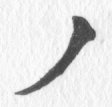
then she draws another curving downwards from left to right, thus: -
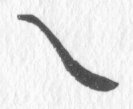
joining the two so as to form the perfect ji, or character, hito, meaning a person of either sex, or mankind: -
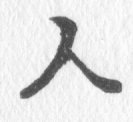
Then she tries to impress the idea of this shape on the baby memory by help of a practical illustration, - probably learned at school. She breaks a slip of wood in two pieces, and manages to balance the pieces against each other at about the same angle as that made by the two strokes of the character. "Now see," she says: "each stands only by help of the other. One by itself cannot stand. Therefore the ji is like mankind. Without help one person cannot live in this world; but by getting help and giving help everybody can live. If nobody helped anybody, all people would fall down and die."
This explanation is not philologically exact; the two strokes evolutionally standing for a pair of legs, - all that survives in the modern ideograph of the whole man figured in the primitive picture-writing. But the pretty moral fancy is much more important than the scientific fact. It is also one charming example of that old-fashioned method of teaching which invested every form and every incident with ethical signification. Besides, as a mere item of moral information, it contains the essence of all earthly religion, and the best
part of all earthly philosophy. A world-priestess she is, this dear little maid, with her dove's voice and her innocent gospel of one letter! Verily in that gospel lies the only possible present answer to ultimate problems. Were its whole meaning universally felt, - were its whole suggestion of the spiritual and material law of love and help universally obeyed, - forthwith, according to the Idealists, this seemingly solid visible world would vanish away like smoke! For it has been written that in whatsoever time all human minds accord in thought and will with the mind of the Teacher, there shall not remain even one particle of dust that does not enter into Buddhahood.